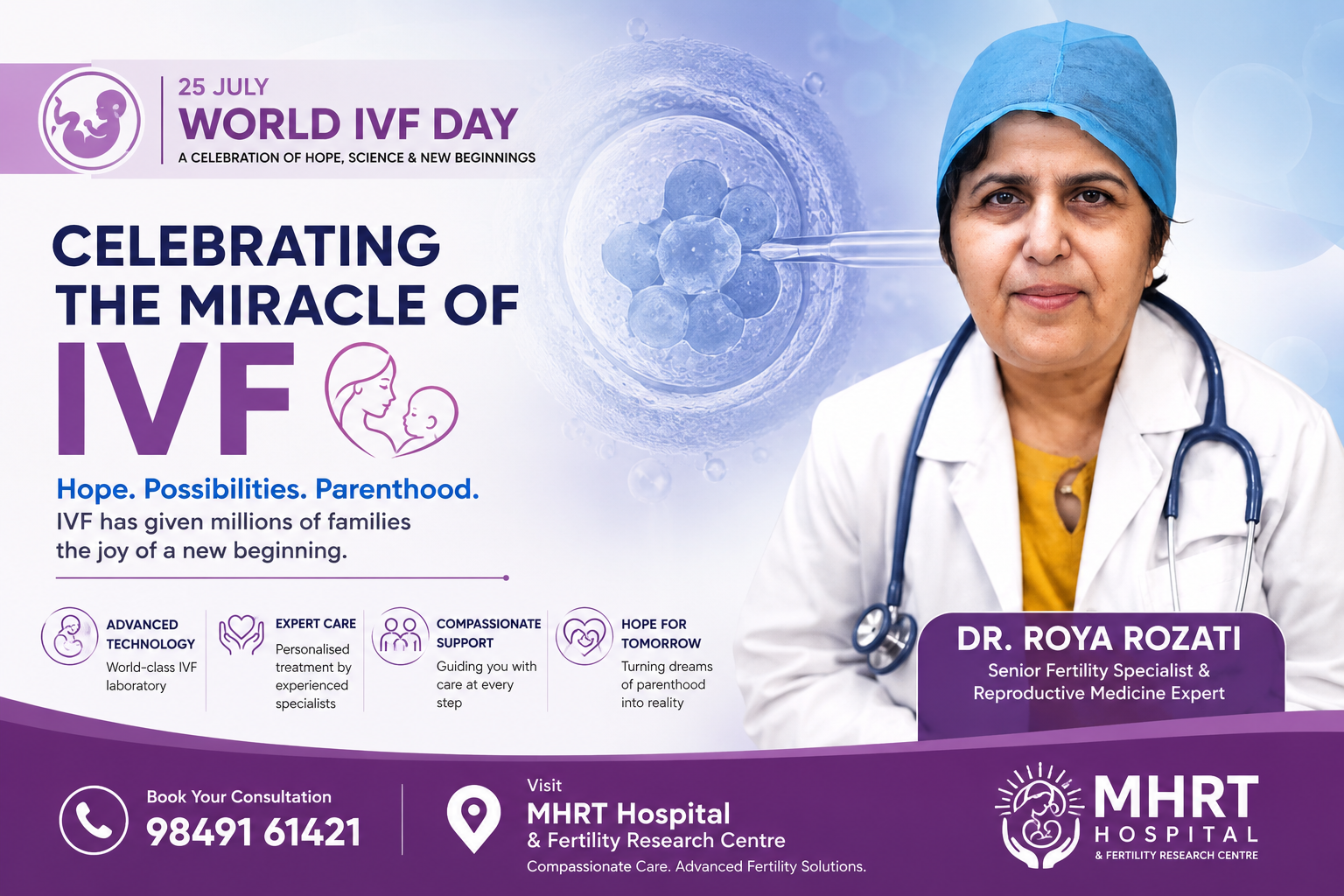
Medical Director MHRI Hospitals, Senior Fertility Specialist & Reproductive Medicine Expert
MHRT Hospital & Fertility Research Centre
Every year on 25 July, the world comes together to celebrate World IVF Day, also known as World Embryologist Day. This special occasion marks one of the greatest breakthroughs in modern medicine – the birth of Louise Brown, the world’s first baby conceived through In Vitro Fertilization (IVF) on 25 July 1978 in Oldham, England.
Her birth changed history forever.
What was once considered an impossible dream suddenly became a reality. Couples who had struggled with infertility now had a new reason to hope. A medical innovation that was initially viewed with skepticism has since transformed into one of the most successful achievements in reproductive medicine.
Today, nearly five decades later, IVF has helped bring millions of babies into the world and has restored hope to families across every continent.
World IVF Day is not merely a celebration of a scientific discovery—it is a celebration of hope, resilience, compassion, and the unwavering determination of couples who refuse to give up on their dream of becoming parents.
Why World IVF Day Matters
Infertility is far more common than many people realize.
According to the World Health Organization (WHO), approximately one in six people worldwide experience infertility at some point during their reproductive years. This means that millions of couples silently face emotional, physical, and psychological challenges while trying to build a family.
Yet, despite how common infertility is, it often remains surrounded by misunderstanding, stigma, and unnecessary guilt.
Many couples suffer in silence because they fear being judged. Others delay seeking medical advice, believing that time alone will solve the problem.
World IVF Day serves as an important reminder that infertility is a medical condition – not a personal failure. Like diabetes, hypertension, or asthma, it deserves proper diagnosis, compassionate care, and evidence-based treatment.
The Journey from “Impossible” to “Possible”
When the first IVF procedure resulted in the birth of Louise Brown in 1978, it represented years of scientific dedication by pioneers who believed that medicine could overcome one of humanity’s greatest challenges.
At that time, the concept of fertilization outside the human body sounded extraordinary.
Many questioned whether it was ethical.
Some believed it would never succeed.
Others doubted whether children conceived through IVF would be healthy.
History has answered those questions.
Today, IVF is practiced safely in countries across the world and has become a standard treatment for many forms of infertility. Millions of healthy children conceived through assisted reproductive technologies are now living proof of how science can transform lives.
More Than a Medical Procedure
One of the biggest misconceptions about IVF is that it is simply another medical treatment.
In reality, IVF represents something much deeper.
For many couples, it marks the end of years filled with uncertainty, disappointment, unanswered questions, and emotional exhaustion.
It is the first ray of hope after repeated pregnancy losses.
It offers possibilities to couples affected by blocked fallopian tubes, severe male factor infertility, endometriosis, ovulation disorders, unexplained infertility, diminished ovarian reserve, and several other reproductive challenges.
Behind every successful IVF pregnancy is not just medical science but also extraordinary courage, patience, optimism, and trust.
Breaking the Silence Around Infertility
One of the most important messages of World IVF Day is that infertility should never be viewed as a source of shame.
Across cultures, many myths continue to persist.
Some people assume infertility is always a woman’s problem.
Others believe that stress alone causes infertility.
Some think fertility treatment should be delayed indefinitely in the hope that nature will eventually take its course.
These misconceptions often prevent couples from seeking timely medical evaluation.
The reality is that infertility can affect both men and women. In many cases, the cause may involve both partners or remain unexplained despite thorough investigations.
Early consultation with a fertility specialist can identify many treatable conditions and help couples make informed decisions about the most appropriate treatment options.
The Gift of Hope
Perhaps the greatest contribution of IVF has been the gift of hope.
Every year, thousands of couples who once believed parenthood was beyond their reach welcome healthy babies into their families.
For them, IVF is not merely a scientific procedure.
It is the first heartbeat seen on an ultrasound.
The first tiny pair of baby shoes.
The first birthday celebration.
The first time they hear the word “Mom” or “Dad.”
These moments remind us that medicine is not only about treating diseases. It is also about restoring dreams.
Looking Beyond the Technology
As we celebrate World IVF Day, it is important to remember that success in fertility treatment depends on far more than advanced technology.
Compassion.
Individualized care.
Clinical expertise.
Accurate diagnosis.
Modern embryology laboratories.
Continuous scientific learning.
These are the foundations upon which successful fertility care is built.
Every patient is unique, and every fertility journey deserves a treatment plan tailored to individual medical needs rather than a one-size-fits-all approach.
A Message to Couples Trying to Conceive
If you have been trying to conceive without success, know that you are not alone.
Seeking help is not a sign of weakness, it is a positive step toward understanding your reproductive health and exploring the options available to you.
Advances in reproductive medicine now offer effective solutions for many causes of infertility. Early evaluation often provides clarity, reassurance, and, in many cases, a clear path forward.
Whether treatment involves lifestyle changes, medication, minimally invasive procedures, or assisted reproductive technologies such as IVF, the most important step is seeking timely guidance from a qualified fertility specialist.
Celebrating Science, Celebrating Families
World IVF Day is ultimately a celebration of human ingenuity and compassion.
It honors the scientists whose research changed the course of reproductive medicine.
It recognizes embryologists whose precision and dedication help create new beginnings every day.
It celebrates fertility specialists who walk alongside couples through one of the most emotional journeys of their lives.
Most importantly, it celebrates every family whose story stands as a testament to perseverance, hope, and the remarkable possibilities of modern medicine.
As we commemorate World IVF Day, let us also reaffirm a simple but powerful message:
Infertility is treatable. Hope is real. And every couple deserves access to compassionate, evidence-based fertility care.
About Dr. Roya Rozati
Dr. Roya Rozati is a distinguished fertility specialist with decades of experience in reproductive medicine, infertility management, and assisted reproductive technologies. Through her work at MHRT Hospital & Fertility Research Centre, she has helped countless couples pursue their dream of parenthood with personalized, evidence-based care.
Take the First Step Towards Parenthood
If you have been trying to conceive or would like to understand your fertility health better, seeking expert advice at the right time can make a significant difference.
Book an appointment with Dr. Roya Rozati for a comprehensive fertility evaluation and personalized treatment plan.
📞 Call: 98491 61421
🏥 Visit:
MHRT Hospital & Fertility Research Centre
Let us help you take the next step on your journey towards parenthood with compassion, expertise, and advanced fertility care.
Disclaimer: This article is intended for educational purposes only and should not be considered a substitute for professional medical advice, diagnosis, or treatment. Always consult a qualified fertility specialist for personalized guidance.
Leave a Reply