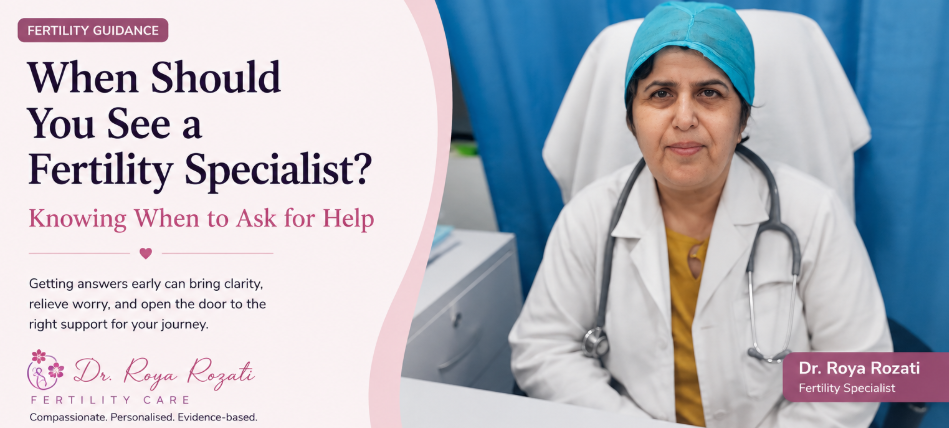
One of the most difficult parts of trying to conceive can be knowing when to stop waiting and start asking questions.
You may tell yourself that it will happen next month. You may wonder whether you are simply being impatient. And sometimes, there is no reason to worry at all.
But if pregnancy is not happening, a fertility consultation can help replace uncertainty with clarity.
When Should You See a Fertility Specialist?
There is no single timeline that is right for every couple.
If you have been trying to conceive without success, or if you already know that you have a condition that may affect fertility, it can be worthwhile to speak with a fertility specialist rather than continuing to wonder on your own.
The purpose of the first consultation is not necessarily to begin treatment. It is to understand your reproductive health, look for possible reasons pregnancy may not be happening, and decide whether any evaluation or treatment is appropriate.
When Should You Not Wait?
You may also need an evaluation sooner if you have:
- Very irregular or absent periods
- A history suggesting problems with ovulation
- Endometriosis or suspected endometriosis
- Previous pelvic surgery
- Known or suspected problems with the fallopian tubes
- A history of pelvic infection
- Previous fertility problems
- A medical condition or treatment that may affect fertility
- Known or suspected male-factor fertility problems
ASRM recommends that fertility evaluation should not be delayed when there is a known condition associated with infertility.
A Consultation Does Not Mean IVF
One of the biggest fears couples have is that seeing a fertility specialist automatically means they will be told to undergo IVF.
It does not.
A consultation is about finding answers. Depending on your history, your doctor may recommend tests to understand ovulation, the uterus, fallopian tubes or sperm health. Sometimes the reason is straightforward and manageable. Sometimes further evaluation is needed.
The important thing is to understand your individual situation before deciding what to do next.
The Bottom Line
You do not have to wait until you feel desperate before asking for help.
For many couples, a fertility consultation is simply the first step toward understanding what is happening. It does not automatically mean IVF, and it does not mean you have failed.
The right time to seek help is personal, but you should not feel that asking for help means something has gone wrong.
If you are unsure whether it is time to see a fertility specialist, a consultation can help you understand where you stand and what your next step should be.
Frequently Asked Questions
Q: When should I see a fertility specialist?
A: If you have been trying to conceive without success or have a known condition that may affect fertility, a fertility consultation can help identify possible causes and appropriate next steps.
Q: Does seeing a fertility specialist mean I need IVF?
A: No. A fertility consultation is primarily about understanding your reproductive health and identifying possible reasons for difficulty conceiving. IVF is only one possible treatment option.
Q: What happens during a fertility consultation?
A: Your fertility specialist may review your medical and reproductive history and, depending on your circumstances, recommend tests to evaluate ovulation, the uterus, fallopian tubes or sperm health.
Q: Should both partners be evaluated for infertility?
A: Yes. Fertility difficulties can involve either partner, so evaluating both partners can help provide a more complete picture.
For consultation and appointments, call us at: 9849161421
Leave a Reply